
Electrical Panel Upgrades for EV Chargers in Leander, TX
Many EV charger installations go smoothly on the existing panel — but when a home's electrical service cannot safely carry a new 40- to 60-amp charging circuit, a panel upgrade comes first. Leander EV Charger Pros is a free referral service: call us and we will connect you with independent local electricians in Leander who can assess your panel, perform a proper load calculation, and upgrade your service if needed.
Free referral service — we connect you with independent local installation professionals. We do not perform installations ourselves.
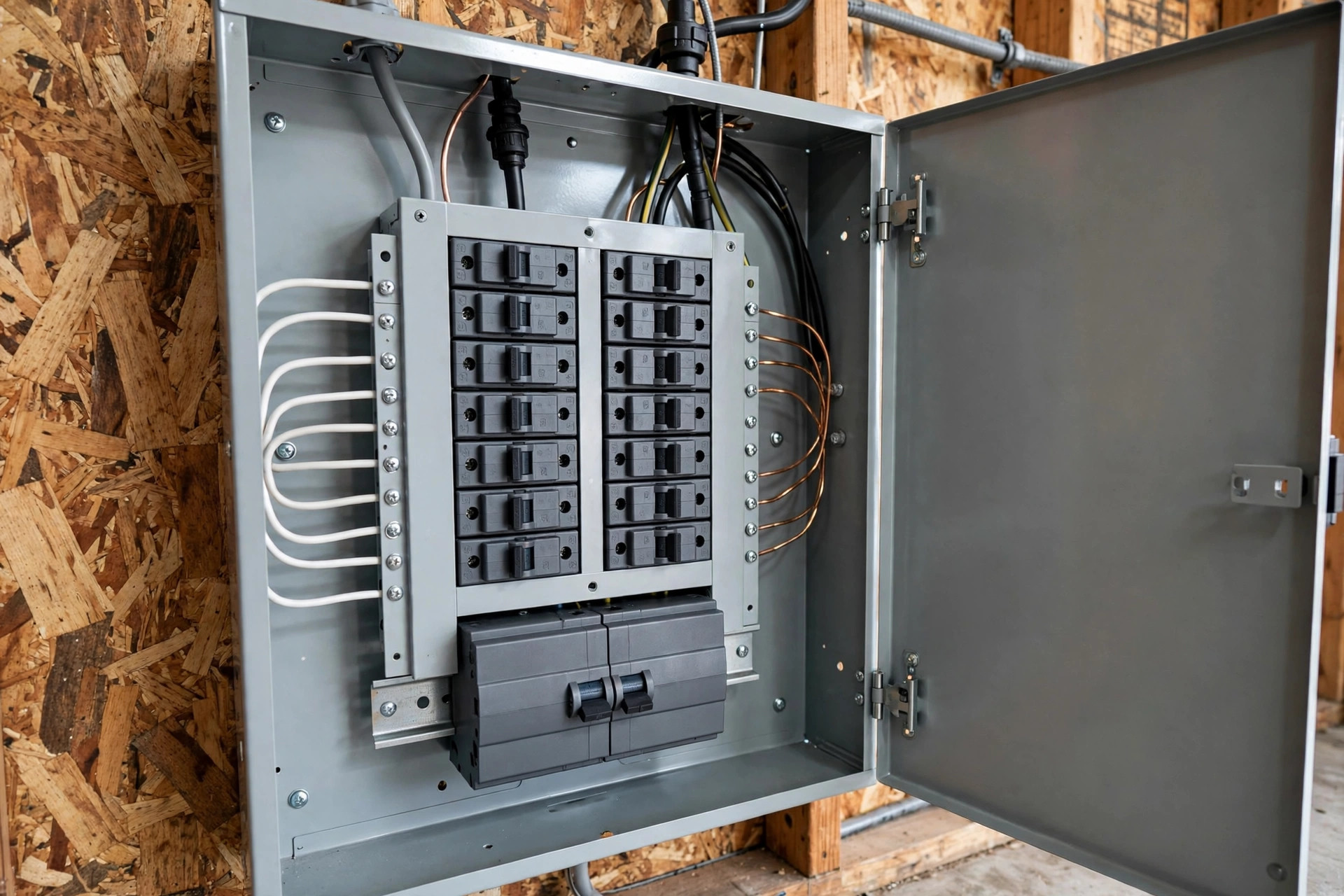
Why EV Chargers Trigger Panel Upgrades
Think of your electrical panel as your home's power budget. A Level 2 EV charger is one of the hungriest single loads in a house — a 40- to 60-amp circuit running for hours, comparable to an electric range or a large air conditioner. On a modern 200-amp service with spare breaker slots, there is usually room. On a 100-amp service, or a panel that is already full of double breakers feeding HVAC, water heating, and a workshop, the math may not work.
Electricians do not guess at this. They run a load calculation — a standardized method that totals your home's existing loads against its service size — and the result says plainly whether the charger fits. If it does not, the options are a panel/service upgrade, a smaller charging circuit, or a load-management device that throttles charging when other loads peak.
If you are planning a Tesla Wall Connector on a 60-amp circuit, panel capacity is the first thing to verify — it is the most demanding common home setup, and the provider will check it before quoting the charger install.
Signs Your Panel May Need an Upgrade
- 100-amp main breaker: the classic flag — a century of electrical progress ago this was standard; an EV circuit strains it.
- No open breaker slots: a panel crammed with tandem breakers and no room for a new 240-volt circuit.
- Frequent breaker trips: especially when the AC kicks on or several appliances run at once.
- Fuse box instead of breakers: still found in some older Leander-area homes — an upgrade is overdue regardless of the EV.
- Flickering or dimming lights: when large loads start, the system is telling you it is near its limit.
- Warm panel or burning smell: stop and call an electrician — this is a safety issue, not just a capacity question.
None of these are a do-it-yourself diagnosis. When Leander EV charger installation professionals assess a home, the load calculation is the step that turns suspicion into a number — and that number decides whether your charger project is a simple circuit run or a panel upgrade first.
How a Panel Upgrade Project Works
- Call for your free referral. Describe your home and your EV charging plans. We connect you with an independent local electrician — free, no obligation.
- Load calculation and assessment. The electrician evaluates your service size, panel condition, and meter equipment, then recommends an upgrade path — or confirms you do not need one.
- Upgrade and charger circuit. The panel is replaced (often 100A to 200A), service entrance wiring is upgraded as needed, and the EV charger circuit is installed in the same project. The utility coordinates a brief power shutoff.
- Permit, inspection, power-up. The job is permitted and inspected, power is restored, and your charger is tested and ready.
Bundling the charger circuit with the panel upgrade is usually the smart move — one permit, one inspection visit, one day of disruption. The residential charging installation in Leander that providers quote most often for older homes is exactly this combined project.
Panel Upgrades in Leander's Housing Mix
Leander's housing stock tells two stories. The subdivisions built during the city's boom years — most of what you see across 78641 and 78645 — typically have 200-amp service and modern panels, and EV charger installs there rarely need electrical upgrades. But Leander also has older homes, rural properties toward Liberty Hill and Jonestown, and houses where previous owners filled every breaker slot with additions. Those are the homes where a provider is most likely to recommend an upgrade.
There is also a middle path worth knowing about: load-management devices. These monitor your home's total electrical draw and automatically pause or reduce EV charging when the air conditioner or water heater is running hard. For some homes they make a charger possible without a full panel replacement. Whether that fits your situation is a question for the load calculation — and for the independent electrician we connect you with, not a guess.
What Affects the Cost of a Panel Upgrade
Panel upgrades vary widely, and we do not quote prices — the electrician who sees your setup gives you the real number. Cost factors include:
- Service size jump: 100A to 200A is the common upgrade; larger jumps or three-phase work cost more.
- Service entrance work: if the mast, meter base, or underground/overhead service conductors need replacement, that adds labor and materials.
- Panel location: a panel in an accessible garage wall is simpler than one buried behind finished walls or in a tight crawlspace.
- Bundled charger circuit: adding the EV circuit during the upgrade is efficient, but it is still additional wire, breaker, and labor.
- Utility coordination: meter pulls and reconnects are scheduled with the utility; some situations need utility-side upgrades.
- Permit and inspection: typically included in the quote.
Call (512) 564-8225 for a free referral to a local electrician who can run the load calculation and give you a straight answer on whether you need an upgrade at all.
Frequently Asked Questions
Why would an EV charger require a panel upgrade?
A Level 2 charger needs a dedicated 240-volt circuit, commonly 40–60 amps — one of the largest single loads in a home. If your panel is full, your service is only 100 amps, or a load calculation shows insufficient spare capacity alongside your HVAC and other loads, the electrician may recommend upgrading the panel before the charger goes in. It is a safety and code question, not an upsell.
What are the signs I need a panel upgrade?
Common signs: a 100-amp main breaker, no open breaker slots, breakers that trip frequently, an old fuse box, or lights that flicker when large appliances start. A warm panel or burning smell is a safety issue — call an electrician promptly. A licensed electrician confirms the need with a load calculation.
What does a panel upgrade involve?
Typically: a load calculation, replacing the panel with a higher-capacity one (often 200 amps), possibly upgrading the service entrance wiring and meter equipment, a brief scheduled power shutoff coordinated with the utility, and permit plus inspection. The EV charger circuit is usually installed as part of the same project.
Can I avoid a panel upgrade with a load management device?
Sometimes. Load management devices monitor your home's total draw and pause or reduce EV charging when other large loads are running, which can let a charger fit on a panel that would otherwise be maxed out. Whether it works for your home depends on the load calculation — ask the provider during the assessment.
What is the difference between 100-amp and 200-amp service?
Amperage is your home's total electrical capacity. 100-amp service was standard decades ago and gets tight once a 40–60 amp EV circuit joins air conditioning, electric water heating, and modern appliances. 200-amp service is the modern standard and comfortably supports an EV charger with room for future additions.
Will my power be out during a panel upgrade?
Yes, typically for part of the day while the panel is swapped and the utility reconnects the meter. Providers schedule this in advance so you can plan around it — charge your devices, plan meals, and keep the fridge closed.
Not Sure Your Panel Can Handle an EV Charger?
Call now for a free referral to an independent local electrician in Leander, TX. Get a proper load calculation and an honest answer — upgrade, load management, or neither.
Call Now for Your Free Quote